Traveling around Europe has become much easier with the introduction of the Schengen Area, which unites 27 countries. Obtaining a single Schengen visa allows you to move freely between member states without additional visa formalities. However, to get the visa you must complete several steps, each requiring attention to detail.
In this article you will find a detailed guide on how to obtain a Schengen visa, avoid mistakes, and increase your chances of approval.
What Is a Schengen Visa
A Schengen visa is a permit for short-term stays (up to 90 days within any 180-day period) in Schengen Agreement countries. The list includes Germany, France, Italy, Spain, Poland, Czechia, and other popular European destinations.
Your visa can be:
- Single-entry, if you plan only one entry;
- Double-entry, if you need to return;
- Multiple-entry — for frequent travel (see “Multiple-entry Schengen Visa”).
Step 1. Choose Your Consulate
Before gathering documents, determine which country’s consulate to apply to. Follow this rule:
- If you visit only one country, apply there.
- If you visit multiple countries, apply at the consulate of the one where you will spend the most days.
- If your stay is split equally, apply at the consulate of your first entry country.
Violating the main-stay rule can lead to refusal or border issues. Read more: “How to Choose Your Schengen Visa Country”.
Step 2. Prepare Your Documents
Required documents vary by trip type (tourist, business, guest), but all applicants need:
- Passport valid at least 3 months after departure;
- Visa photo (see “Visa Photo Requirements”);
- Completed visa application form;
- Travel medical insurance covering at least €30 000 (see “Medical Insurance for Visa and Travel”);
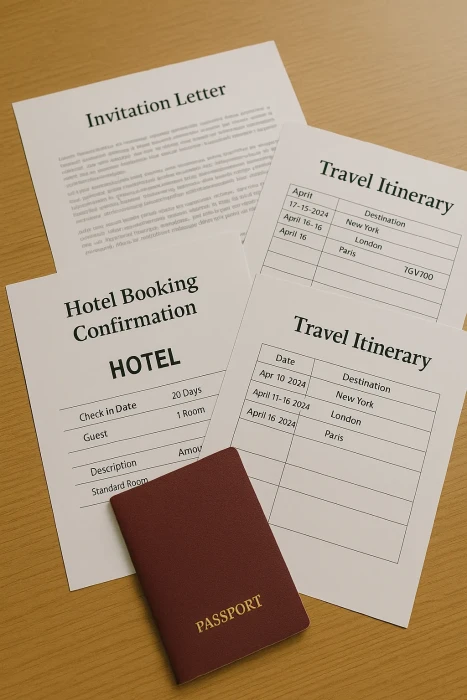
- Proof of itinerary: flight and hotel bookings;
- Financial proof: bank statements, income certificate;
- Employment letter or other proof of ties to home country.
For a full checklist, see “Complete List of Visa Documents”.
Step 3. Submit Your Application
You typically submit via the visa application center for your chosen country (e.g., VFS Global, TLScontact).
Key points:
- Book your appointment online — ideally 2–3 weeks in advance;
- You may apply up to 6 months before travel (minimum 15 days before);
- If you haven’t provided biometrics in the last 59 months, you must appear in person (see “Visa Biometrics: Procedure”).
At submission, you pay the consular fee and any application center service fee.
Step 4. Wait for Decision & Collect Your Visa
Standard processing takes 7–15 working days, but can be longer during peak season.
When your visa is ready, you receive notification. Upon passport return:
- Check visa details: name, validity dates, number of entries.
- Ensure the dates match your plans.
- Verify the visa type (C — short-stay).
If there are any errors, contact the visa center immediately.
Tips for Success
- Be precise with travel dates. Mismatches raise doubts.
- Follow the 90/180 rule. Exceeding it risks a ban.
- On repeat travel, you may qualify for a multiple-entry visa.
- After a refusal, see “Visa Refusal: Next Steps” before reapplying.
Conclusion
A Schengen visa is not just entry permission but your pass to Europe. Take the process seriously: prepare your documents carefully, choose the right consulate, and adhere to all requirements.
If this is your first visa or you’re unsure, trust professionals. We will prepare your application, review your form, insurance, and itinerary to maximize approval chances on your first try.
Ready to explore Europe? Start with our step-by-step Schengen visa guide — and let your journey begin with proper preparation!