International negotiations, conference attendance, business trips abroad — these are integral parts of modern professional life. However, traveling to most countries for business purposes requires a special type of visa — a business visa. It is distinct from tourist or work visas: a business visa has its own purposes, limitations, and application procedures. In this article, you will learn when a business visa is required, which documents you need to prepare, and how to navigate the consulate interview.
When a Business Visa Is Required
A business visa is necessary if you plan a short-term trip abroad for professional activities. It is appropriate for:
- Participating in business negotiations;
- Attending conferences, forums, or business events;
- Business trips to meet partners or clients;
- Participation in trade shows and industry events;
- Discussing contracts, collaborations, or project launches.
Important: a business visa does not grant the right to be employed in the host country. If you plan to work or receive a salary from a foreign company, you must apply for a work visa, not a business visa.
Main Applicant Requirements
To obtain a business visa, you must prove you are traveling for business purposes and will return home after your trip. Key requirements include:
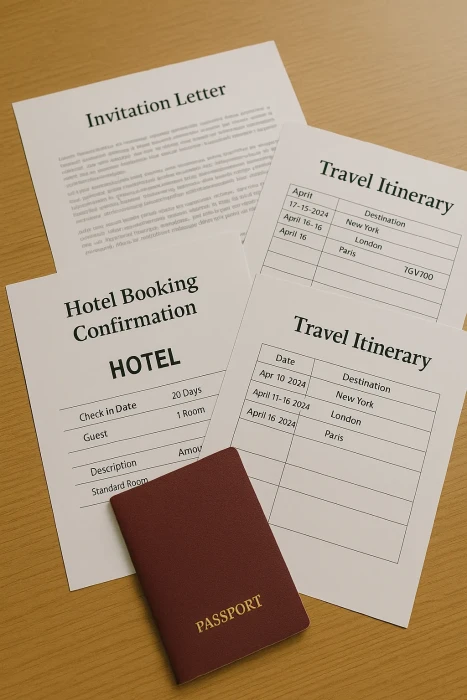
- An invitation from the foreign company or event organizer (on official letterhead, signed and stamped);
- A letter from your employer confirming the trip’s purpose, duration, and that they will cover expenses;
- Documents demonstrating financial capability;
- Proof of hotel and transportation bookings;
- A detailed itinerary or schedule of business meetings, plus business cards.
🔹 For invitation templates and document samples, see “Invitation Letter for a Visitor Visa”; the format is similar for business visits.
Documents Required for a Business Visa
You will typically need the following documents:
- Passport (valid at least 6 months beyond your planned departure date);
- Invitation from the host;
- Employer’s letter stating the trip’s purpose;
- Proof of funds (bank statement or company guarantee);
- Hotel and flight bookings;
- Event program or meeting schedule;
- Business cards and company information (helpful for the interview).
🔹 Even if short business trips sometimes fit under a tourist visa, it’s best to declare your correct purpose to avoid border issues or future application denials. See “Tourist vs Visitor Visa” for more distinctions.
Interview Tips
Many countries (e.g., USA, Canada, UK) require a consular interview for a business visa. Common questions include:
- Which company do you work for?
- Who is organizing your trip?
- Who will you meet?
- Do you have business partners abroad?
- What is the purpose and outcome of your visit?
🔹 Tip: Answer clearly and professionally, backed by documents. Confidence and logical responses boost approval chances. The consul must be convinced you’ll return after completing your specific business goals.
When You Might Use a Tourist Visa Instead
Some countries allow attending minor business events on a tourist visa if you are not signing contracts or acting on behalf of your company. However, this is the exception rather than the rule.
For example, in the USA, the B1 visa is explicitly for business visits, while B2 visas cover tourism and personal trips. See the USA visa page for full details on categories.
🔹 Tip: Always choose the visa type that matches your purpose. Mismatched information is a common reason for denial.
Conclusion
A business visa is the official channel for participating in international business activities. It does not allow employment but does permit participation in negotiations, meetings, and professional events. Correct visa selection, a clear purpose, complete documentation, and a confident interview are key to a successful application.
We offer assistance with business visas for the USA, Canada, UK, Australia, Japan, China, and Schengen countries. We will guide you through document preparation, invitation letters, and interview coaching.