Visa processing — it’s not just a formality but an important step that directly affects the success of your trip. Regardless of the purpose of your visit — whether tourism, study, work, or personal visits — proper and timely preparation for submitting the visa application significantly increases your chances of approval. In this article, we will explore in detail where to start and how to avoid common mistakes when preparing documents.
Why Thorough Preparation for a Visa Application Is Important
Each consulate or visa center evaluates an application according to several criteria: the presence of all required documents, their correctness and authenticity, the consistency of information in the form and certificates, as well as the stated purpose of travel. Errors or inaccuracies can lead to delays or even a visa refusal.
That is why it is so important to pay attention to every step:
- verify the current visa requirements of the destination country (for example, US visa rules differ from Schengen visa requirements),
- assemble a correct and complete document package,
- fill out the application form accurately,
- submit the documents on time for review.
When to Start the Visa Process
The optimal time to apply depends on the country, but the general recommendation is to begin preparations 1–3 months before the intended trip. This allows you to:
- prepare all documents in advance,
- schedule an appointment at a convenient time,
- if necessary, use expedited document submission (see urgent visa processing),
- factor in possible delays or additional requests from the consulate.
For example, appointments at Schengen visa centers can open up to 6 months before travel, while US visas require an interview that can be difficult to schedule on short notice.
What Documents Are Needed for a Visa
Although the list may vary depending on the type of visa and country, the basic package of documents usually includes:
- passport (valid for at least 6 months beyond the end date of travel),
- completed visa application form,
- photo meeting the required specifications,
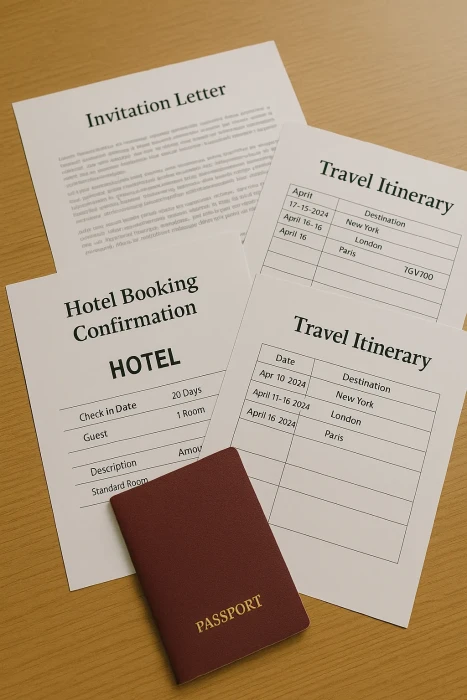
- proof of trip purpose (invitation, hotel booking, itinerary),
- financial documents (bank statements, income certificates),
- medical insurance (for the Schengen Area and some other countries).
We recommend checking in advance the list of requirements on the official page of the destination country, for example, the Canada visa page, the Japan visa page, or the UK visa page.
It is also useful to refer to the article "Visa Documents: Complete List of Required Certificates", which details exactly which documents are required in each specific case.
How to Fill Out the Visa Application Form Correctly
One of the most common reasons for refusal is errors in the application form. To avoid this, pay attention to the following points:
- Complete the form in the language specified by the embassy’s requirements. Usually English or the local language.
- Use data from your passport. This is especially important for name transliteration.
- Provide only truthful information. Do not embellish the purpose of your trip or falsify documents.
- Ensure consistency of information. All documents and the form must contain matching data.
If you encounter difficulties, we recommend using professional assistance in filling out the form to avoid possible refusals.
Scheduling Document Submission
In most cases, document submission is done by appointment at a visa center or consulate. The process may differ depending on the country:
- In the USA, registration on the consulate’s website, payment of the consular fee, and selection of an interview date are required.
- In the UK and Canada, appointments are made through online platforms.
- For the Schengen Area, via VFS Global or TLScontact visa centers.
We recommend planning your submission date in advance, especially during peak season (spring–summer). If your trip is urgent, you can use the urgent submission service (see urgent visa processing), but it may require additional documents or a higher consular fee.
Conclusions
Preparing to submit a visa application is not just gathering papers but a systematic series of steps, each of which affects the final decision of the embassy. Plan your submission in advance, be careful when filling out the form and gathering documents, take into account the visa policy specifics of each country, and seek professional support if necessary.
If you want assistance with obtaining a tourist visa to the USA, a visitor visa to the UK, a student visa to Canada, or a business visa to China, we will be happy to advise you at every stage.